
A homeowner in Brookside vacuums up small brown beetles along a basement baseboard every few days for months and assumes they are wandering in from outside. A homeowner in Olathe finds a cashmere sweater with small holes that were not there last winter and a scatter of shed shells underneath it in the closet. A homeowner in the Northland notices a faint odor near a particular wall, then spots a line of tiny beetles along the floor trim beneath it, and only later realizes the two observations are connected. Kansas City pest control providers that field stored-product and fabric pest calls, including ZipZap Termite & Pest Control in Lawson, see dermestid beetles constantly, and the species is probably the most underappreciated household pest across the metro. The beetles themselves are not the main problem. What they are eating, and where, usually is.
What Dermestid Beetles Actually Are
Dermestids are a family of small beetles (Dermestidae) that specialize in eating dry protein-based material: wool, leather, silk, feathers, fur, dried meat, horn, hair, dead insects, and in natural settings, animal carcasses after the softer tissues have decomposed. The family contains hundreds of species, but several are common enough in Kansas City homes to account for nearly all residential dermestid calls.
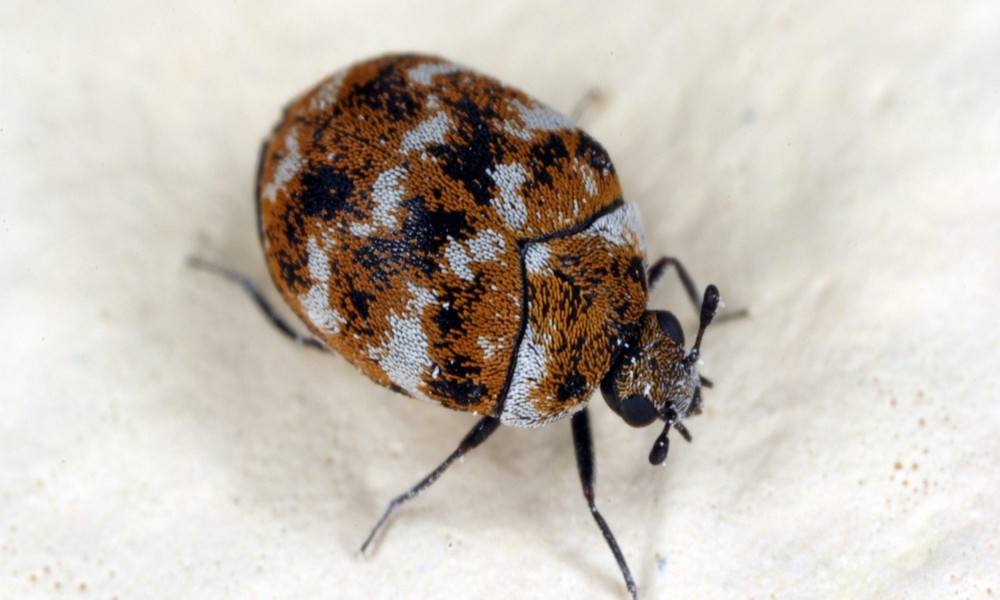
The varied carpet beetle (Anthrenus verbasci) is a small, round, mottled beetle about 1/16 to 1/8 inch long, patterned in brown, yellow, and white. Adults are often found on windowsills in spring because they are attracted to light and feed on pollen outdoors.
The furniture carpet beetle (Anthrenus flavipes) is similar in size with a more yellow-and-black scale pattern.
The black carpet beetle (Attagenus unicolor) is larger, typically 1/8 to 3/16 inch, dark brown to black, and more elongated than the round varied species.
The larder beetle (Dermestes lardarius) is the most distinctive, about 1/4 to 3/8 inch with a broad yellowish band across the upper wing covers dotted with black spots. Larder beetles are the species most often associated with dead animals in walls.
The hide beetle (Dermestes maculatus), used commercially for skeletal cleaning in museums and taxidermy, occasionally shows up in residential settings wherever sufficient animal material has accumulated.
The larvae matter more than the adults for identification. Dermestid larvae are small, tapered, and covered in bristly hairs, often described as looking like tiny fuzzy worms. The larvae do the feeding damage, and the shed skins (exuviae) they leave behind as they molt are one of the most diagnostic signs of an active population.
What the Presence of Dermestids Actually Signals
This is where dermestid ecology diverges from how homeowners usually interpret a beetle sighting. Seeing a handful of dermestid beetles in a home does not generally mean the beetles wandered in from the garden. It usually means an established food source exists somewhere in the structure.
Several common sources drive most residential dermestid populations.
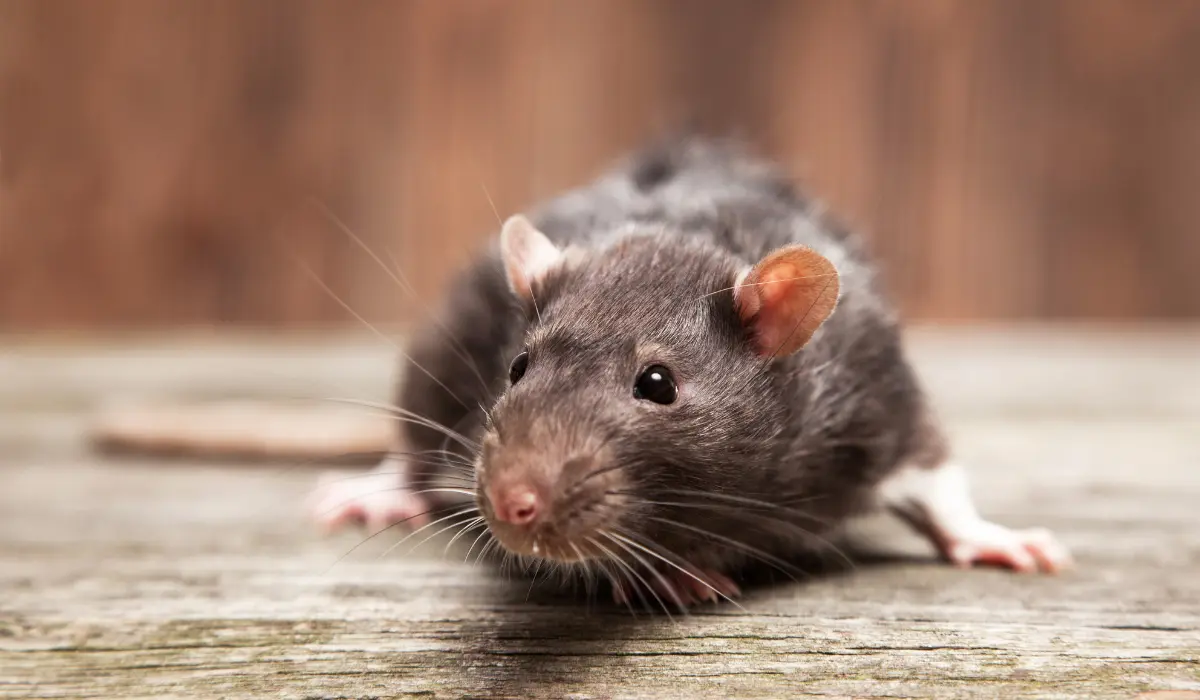
Dead animals in wall voids or attic spaces. A mouse that died in a wall after rodent bait exposure, a bird that nested and died in a gable vent, a raccoon or squirrel remnant in an attic: any of these provides a significant food source for dermestid larvae that can sustain a population for months or years. Larder beetles in particular are strongly associated with this scenario.
Accumulated dead insects. Cluster flies in an attic, paper wasps in a soffit, overwintering stink bugs in a wall void, or generations of dead cluster flies and lady beetles on an attic floor all feed dermestid populations. The University of Missouri Extension and similar programs consistently point to dead insect accumulations as the single most common hidden dermestid food source in residential structures.
Stored animal products. Wool sweaters, felt hats, silk ties, leather-bound books, fur-trimmed coats, down pillows, feather-stuffed dog toys, taxidermy mounts, old tack and leather goods in storage, and mothballed formal wear can all support dermestid populations for years if stored improperly.
Pet-related material. Accumulated pet hair under rarely-moved furniture, dog bedding stored without cleaning, aquarium residue (dried fish food contains animal protein), and the dust-and-hair mix that collects in rarely-vacuumed corners all provide dermestid food.
Bird and rodent nests. Old nests in attic spaces and chimney chases contain feathers, fur, insect debris, and other dermestid food, and they often persist for years after the nest builders leave.
The key insight is that the visible beetles are almost always downstream of a hidden source. Finding and eliminating the source is the treatment. Killing the visible beetles without finding the source produces short-term reduction and long-term return.
Why Spray Treatment Alone Fails
A homeowner who reaches for a surface insecticide and treats the baseboards where dermestids are seen eliminates the current generation of wandering adults and produces a false sense of resolution. Two weeks later, new adults emerge from the same hidden source and the problem appears to return.
The failure is structural. Dermestid larvae spend most of their development cycle inside the food source itself, protected from surface treatment. Adult beetles are the wandering phase, and by the time a homeowner sees adults along baseboards, windowsills, or light fixtures, the larvae are already developed and producing the next generation in the hidden source.
Spraying the visible beetles also does nothing about the material the beetles are feeding on, which continues to degrade. Wool sweaters with active carpet beetle damage continue losing fibers regardless of how many adults the homeowner kills.
What Actually Controls Dermestid Infestations
Effective treatment is almost entirely about locating and removing the food source.
A thorough inspection starts with the rooms where beetles have been seen and expands outward. Odor can help locate dead animals in walls. Thermal imaging occasionally identifies carcass-driven temperature anomalies. Attic and crawl space inspection often reveals accumulated dead insects, bird and rodent nests, and other dermestid food that has built up over years.
Source removal is the critical step. A dead rodent removed from a wall, a bird nest cleared from a soffit, or a box of old woolens taken out of a closet eliminates the feeding population at the source.
Stored textiles at risk of dermestid damage should be cleaned before long-term storage (dry cleaning kills eggs and larvae) and stored in sealed containers rather than garment bags or cardboard boxes.
Vacuuming aggressively along affected areas removes larvae, adults, shed skins, and food debris. Bag contents should be discarded outside immediately rather than kept in an indoor vacuum canister.
Residual treatment to cracks and crevices can be useful as a secondary measure after source removal, but it is not a substitute for finding the source.
When Kansas City Pest Control Involvement Makes Sense
Dermestid problems that persist after a thorough home search for the source usually warrant professional assessment. The technician has access to thermal imaging, borescope inspection, and experience with the specific locations dermestid populations tend to establish that a homeowner searching alone does not have.
Any dermestid population accompanied by a noticeable odor from a wall or ceiling, any significant fabric damage to stored textiles, and any dermestid activity following a recent rodent issue warrants a call to a Kansas City pest control provider such as ZipZap Termite & Pest Control that can locate the underlying source rather than just treat the symptom.
The Short Version
Dermestid beetles are almost never a standalone problem. They are an indicator of a food source somewhere in the structure, most commonly dead insects in attics, dead animals in wall voids, stored animal-origin textiles, or neglected nests. Finding and removing the source is the treatment. Spraying the visible beetles produces cycles of apparent control followed by recurrence. For Kansas City homeowners seeing repeated dermestid activity, the right next step is a structural inspection that locates the source rather than another round of consumer insecticide.